

You keep scrolling through Bali photos, dreaming about going but something keeps stopping you. Maybe it’s the fear of traveling alone, the worry about safety, or simply not knowing where to start. Here’s the truth: Bali solo travel is one of the most rewarding decisions you’ll ever make, and thousands of solo travelers prove it every single month.
I’ve spoken with dozens of solo travelers who arrived in Bali nervous and left completely transformed. The island has this rare ability to make you feel both free and deeply connected to its culture, its people, and yourself. Solo travel here isn’t lonely; it’s liberating.
In this guide, you’ll discover the safest neighborhoods to stay, the best time to visit, honest budgeting tips, must-see destinations, and practical safety advice. Everything you need to plan your Bali solo trip with total confidence.
Bali Solo Travel Guide: Everything You Need Before You Go
Bali isn’t just a destination. It’s an experience that rewires how you think about travel, freedom, and yourself. Every year, millions of visitors land at Ngurah Rai International Airport and a growing chunk of them are solo travelers who decided to stop waiting for the “perfect travel partner” and just go. Smart move.
Before you pack your bags, though, you need to understand what Bali actually is. It’s not one place with one vibe. It’s a mosaic rice terraces in Ubud, surf breaks in Canggu, clifftop temples in Uluwatu, beach clubs in Seminyak, and volcano hikes in Kintamani. Each corner of this island speaks a different language. Knowing which one speaks to you makes the difference between a trip you enjoy and one you absolutely love.
Here’s what makes Bali uniquely brilliant for solo travelers:
| Factor | Why It Matters for Solo Travel |
| English widely spoken | Easy to communicate everywhere |
| Affordable cost of living | Stretch your budget further |
| Strong solo traveler community | Easy to meet people |
| Diverse experiences | Culture, surf, wellness, food — all in one island |
| Safe reputation | Lower risk compared to many destinations |
| Excellent infrastructure | Transport, SIM cards, ATMs widely available |
Practically speaking, Bali runs on a relaxed rhythm. Nothing moves too fast. That’s both its charm and, occasionally, its frustration. Flights arrive mostly through Denpasar. From there, you’ll need a taxi, a Grab ride, or a pre-arranged airport transfer to reach your destination because no metro system exists here. Plan that first ride in advance. Don’t wing it at the airport; you’ll overpay or end up confused in the chaos.
Visa on arrival is available for most nationalities and costs around $35 USD for 30 days, extendable once for another 30 days. More on that in the visa section. What matters right now is this Bali welcomes solo travelers with open arms, warm smiles, and genuinely beautiful chaos. The island will challenge you, surprise you, and occasionally confuse you. That’s exactly the point.
Is Bali Safe for Solo Travelers? Tips, Risks & Female Travel Advice
Let’s address the elephant in the room first. Is Bali safe? The honest answer is yes but with a few important asterisks. Bali solo travel safety is generally strong compared to many popular destinations worldwide. Violent crime against tourists is rare. However, petty scams, traffic accidents, and overcharging are very real and very common.
The biggest physical danger in Bali isn’t crime it’s the roads. Scooter accidents injure thousands of tourists annually. If you’ve never ridden a motorbike before, Bali is not the place to learn. The traffic in areas like Kuta and Seminyak is genuinely wild. Potholes appear without warning. Rain makes roads slippery. Locals drive fast and confidently. If you decide to ride, wear a helmet, go slowly, and avoid riding at night.
Common scams targeting solo travelers include:
| Scam Type | How It Works | How to Avoid It |
| Taxi overcharging | Drivers quote inflated fares | Always use Grab or negotiate upfront |
| Fake tour operators | Collect money, disappear | Book through verified platforms |
| Monkey Forest theft | Monkeys or humans snatch bags | Keep valuables secured |
| ATM skimming | Card details stolen at ATMs | Use bank ATMs only |
| Currency exchange fraud | Misleading rates or short-changing | Use trusted moneychangers |
| Spiritual scam | “Holy man” demands money for blessing | Politely walk away |
Is Bali Safe for Female Solo Travelers?
Absolutely and millions of women travel Bali solo every year without issues. That said, awareness matters. Female solo travelers in Bali generally report feeling comfortable and respected, especially in tourist-heavy areas. Balinese culture is warm and community-oriented. Locals aren’t typically aggressive toward women.
However, a few practical habits make your experience smoother. Dress modestly when visiting temples cover your shoulders and knees, or use a sarong (usually provided at temple entrances). Avoid walking alone on dark, deserted streets late at night, particularly in Kuta. Trust your instincts. If a situation feels off, leave it. Solo female travelers who thrive in Bali treat it like any other international destination with awareness, confidence, and a healthy sense of street smarts.
Download the Grab app before you land. It’s the safest, most transparent way to get around. Always share your location with someone back home. Stay in well-reviewed accommodations with 24-hour reception. These habits aren’t about fear, they’re about traveling smart.
Best Time to Visit Bali for Solo Travel

Timing your Bali solo travel correctly can transform your entire experience. Get it right and you’ll enjoy smooth sunny days, empty temples, and cheaper prices. Get it wrong and you’ll wade through crowds, monsoon downpours, and inflated hotel rates.
Bali has two distinct seasons: dry season and wet season and they’re not subtle about it.
| Season | Months | What to Expect |
| Dry Season (Peak) | April – October | Sunny, low humidity, crowded, higher prices |
| Wet Season (Off-Peak) | November – March | Heavy rain, fewer tourists, great deals |
| Shoulder Season | April, October | Perfect balance of weather and crowd levels |
The best time for solo travel in Bali is April through June or September through October. Here’s why. July and August are peak months, schools are out across Europe and Australia, prices spike dramatically, and spots like Ubud and Seminyak get genuinely overcrowded. You’ll pay more and enjoy it less.
April to June gives you reliable sunshine, manageable crowds, and competitive accommodation rates. October is arguably the sweet spot; the rains haven’t fully arrived yet, most tourists have left, and the island feels refreshingly calm. You can score a beautiful villa at 40–50% less than August prices.
The wet season (November to March) isn’t as bad as it sounds. Rain typically falls in heavy afternoon bursts, not all day. Mornings are often clear and beautiful. If you’re on a tight budget and flexible with plans, traveling during the wet season can be a genuinely rewarding experience. The rice terraces look impossibly lush and green. Fewer tourists means more authentic connections with locals. Accommodation prices drop significantly. Just pack a lightweight waterproof jacket and embrace it.
Avoid Bali during major Indonesian public holidays like Nyepi (Balinese New Year) unless you specifically want that experience. Nyepi is a day of complete silence, no flights, no outdoor movement, no electricity in many areas. It’s extraordinary to witness but completely disrupts travel logistics.
Best Places to Stay in Bali for Solo Travelers (Budget to Luxury)
Where you sleep in Bali matters more than most people realize. Your accommodation isn’t just a bed it’s your social hub, your safety net, and your daily mood-setter. Solo travelers in Bali have an incredible range of options spanning every budget imaginable.
Budget Accommodation (Under $20/night)
Hostels in Bali have evolved far beyond the dingy dorm stereotype. Places like Tribal Bali in Canggu or Puri Garden Hotel & Hostel in Ubud offer clean dorms, social atmospheres, and communal spaces designed specifically for solo travelers to meet each other. Expect breakfast included, strong WiFi, and organized social events like cooking classes or beach cleanups.
Mid-Range Accommodation ($20–$80/night)
This is where Bali truly shines. For $40–$60 per night, you can stay in a genuinely beautiful private villa with a plunge pool, daily breakfast, and stunning rice terrace views. The value-for-money ratio at this price point is remarkable compared to almost anywhere else in the world. Airbnb and Booking.com both list excellent options across Ubud, Canggu, and Seminyak.
Luxury Accommodation ($100+/night)
If you want to treat yourself, Bali’s luxury offerings are world-class. Properties like Four Seasons Resort Bali at Sayan, Alaya Resort Ubud, and Bulgari Hotels Bali in Uluwatu redefine what a hotel stay can feel like. Private infinity pools overlooking the jungle, personalized butler service, and spa treatments that leave you genuinely speechless.
| Area | Best For | Budget | Vibe |
| Canggu | Digital nomads, surfers | $15–$150 | Cool, trendy, social |
| Ubud | Culture, wellness, nature | $10–$200 | Spiritual, calm, artistic |
| Seminyak | Beach, nightlife, shopping | $30–$300 | Upscale, stylish |
| Uluwatu | Surfing, cliffs, sunsets | $20–$400 | Dramatic, laid-back |
| Sanur | Quiet, older crowd, families | $20–$150 | Peaceful, traditional |
| Kuta | Nightlife, budget travel | $8–$80 | Lively, hectic |
For first-time solo travelers to Bali, Canggu or Ubud are the strongest starting points. Both areas have dense solo traveler communities, excellent cafes, and easy access to transport.
Where to Go in Bali Solo: Top Areas Explained (Ubud, Canggu, Uluwatu & More)
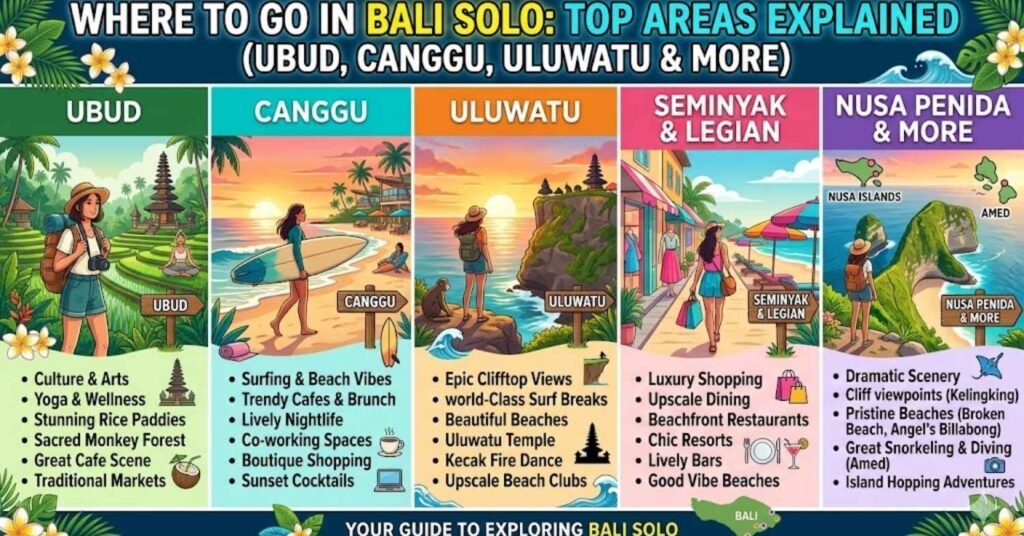
Bali isn’t small. Driving from the northern tip to the southern coast takes roughly three hours on a good traffic day and traffic here is rarely good. Understanding each area before you arrive saves you from making expensive, time-wasting accommodation mistakes.
Ubud sits at Bali’s cultural heart. Rice terraces cascade down hillsides in every direction. The famous Tegalalang Rice Terrace sits just 15 minutes north of town. Ubud’s main street is lined with art galleries, traditional craft shops, organic cafes, and yoga studios. It’s where people go to slow down, journal, and think. Solo travelers who want depth over party culture almost always fall in love with Ubud. The Sacred Monkey Forest Sanctuary is touristy but genuinely fascinating. Cooking classes, silver jewelry workshops, and early morning meditation sessions are daily staples here.
Canggu is Bali’s coolest neighborhood right now and it knows it. Former rice paddies have transformed into Instagram-worthy cafes, co-working spaces, surf schools, and rooftop bars. The Echo Beach and Batu Bolong Beach areas attract a young, international crowd of digital nomads, surfers, and solo travelers. If you want to meet people easily, find great coffee, and work remotely while ocean waves crash in the background, Canggu delivers every time.
Uluwatu occupies Bali’s southern Bukit Peninsula, a dramatic limestone plateau where clifftop temples hang over turquoise water. The famous Uluwatu Temple hosts a nightly Kecak fire dance at sunset that’s genuinely breathtaking. The beaches here Padang Padang, Bingin, Balangan are some of Bali’s most beautiful and least crowded. Uluwatu attracts serious surfers and travelers who value dramatic scenery over convenience.
Seminyak is polished and upscale. Designer boutiques, sophisticated beach clubs like Potato Head and Ku De Ta, and excellent restaurants line its streets. It’s more expensive than Canggu but offers a refined experience. Solo travelers who enjoy people-watching over a good cocktail thrive here.
Sanur gets overlooked and that’s exactly its strength. It’s quieter, more traditional, and genuinely local-feeling compared to the tourist corridors of the south. The Sanur Beach beachfront promenade is perfect for solo morning walks. It’s also the main departure point for fast boats to Nusa Penida and Nusa Lembongan.
Kuta was Bali’s original tourist hub. It’s still the cheapest area to stay and the most chaotic. Think crowded streets, aggressive vendors, and wall-to-wall surf shops. Some travelers love its energy. Many find it overwhelming. For first-timers, spend one or two nights maximum before moving to somewhere with more character.
Perfect Bali Solo Travel Itinerary (3, 5 & 7 Days Plans)
Planning a solo Bali itinerary requires honest thinking about what you actually want. Culture? Beaches? Adventure? Nightlife? Wellness? Bali can deliver all of these but not if you’re jumping between areas every single day. Cluster your stays geographically and you’ll enjoy the island far more deeply.
3-Day Bali Solo Itinerary
Day 1: Arrive & Settle in Ubud Land in Denpasar and head straight to Ubud. Check into your accommodation, walk the main street in the evening, grab dinner at Locavore or a warung (local food stall), and sleep early. Jet lag is real.
Day 2: Ubud Deep Dive Wake up early for the Campuhan Ridge Walk before the heat arrives. Grab breakfast at a rice field café. Visit the Sacred Monkey Forest mid-morning. Spend the afternoon at Tegalalang Rice Terrace. Watch the sunset from a rooftop café.
Day 3: Temple & Departure Visit Tirta Empul (holy water temple) in the morning, one of Bali’s most spiritually powerful experiences. Head back to Denpasar for your flight or extend your trip.
5-Day Bali Solo Itinerary
| Day | Location | Key Activities |
| Day 1 | Arrive → Canggu | Settle in, explore Echo Beach, sunset at Old Man’s Bar |
| Day 2 | Canggu | Surf lesson, café hopping, visit Tanah Lot temple at sunset |
| Day 3 | Transfer to Ubud | Campuhan Ridge Walk, Monkey Forest, cooking class |
| Day 4 | Ubud | Tegalalang Rice Terrace, Tirta Empul, traditional dance show |
| Day 5 | Uluwatu | Padang Padang Beach, Uluwatu Temple, Kecak fire dance |
7-Day Bali Solo Itinerary
Expand the five-day plan and add a full day trip to Nusa Penida on Day 6 the dramatic Kelingking Beach cliff viewpoint alone justifies the boat ride. Use Day 7 for a slower morning in Seminyak: beach club, shopping, and a proper goodbye dinner before your flight.
The golden rule of any Bali solo travel itinerary: don’t overplan. Leave breathing room. Some of the best experiences of a stranger inviting you to a village ceremony, stumbling on a hidden waterfall, and a three-hour conversation at a café happen when you’re not rushing to the next scheduled item.
Best Things to Do in Bali Alone (Unique & Must-Try Experiences)

Doing things alone in Bali isn’t a consolation prize, it’s actually better in many ways. You move at your own pace. You linger where you want. You leave when you’re ready. Nobody is rushing you toward the next Instagram spot.
Here are the best solo experiences in Bali:
Mount Batur Sunrise Trek: Start hiking at 2 AM, reach the summit by dawn, and watch the sun rise over the volcanic caldera as clouds drift below your feet. It’s one of those experiences that physically recalibrates your perspective on life. Join a small group tour since the hike requires a guide and you’ll naturally meet fellow travelers on the way up.
Tirta Empul Holy Water Ritual: Wade into the sacred spring pools of this ancient Hindu temple and participate in a purification ceremony alongside local Balinese worshippers. It’s humbling, beautiful, and completely unlike anything in the typical tourist circuit.
White Water Rafting on the Ayung River: The Ayung River offers exciting Grade II–III rapids through dense jungle, past ancient carvings and waterfalls. Most rafting operators welcome solo travelers and place you with small groups.
Traditional Balinese Cooking Class: Learn to make nasi goreng, satay, tempeh, and jamu (traditional herbal drink) in an open-air kitchen surrounded by a herb garden. The shared experience is one of the easiest ways to bond with other solo travelers.
Yoga and Meditation Retreat: Ubud is the global headquarters of yoga retreats. Options range from a single morning class ($10–$15) to multi-day immersive programs. The Yoga Barn in Ubud is particularly well-regarded.
Watching the Kecak Fire Dance at Uluwatu: As the sun sinks into the Indian Ocean, 50+ male performers create a hypnotic vocal chant while enacting scenes from the Ramayana. It costs around $12 and lasts about an hour. Go alone and it hits differently so you absorb the experience without distraction.
Waterfall Chasing Sekumpul Waterfall in North Bali is arguably the island’s most beautiful cluster of seven cascades plunging into a jungle gorge. Tegenungan Waterfall near Ubud is more accessible. Both are magical when experienced solo.
Hidden Gems in Bali for Solo Travelers (Less Crowded Spots)
The tourist trail in Bali is well-worn and sometimes exhausting. But step even slightly off it and the island reveals a quieter, more authentic version of itself. These hidden gems in Bali reward curious solo travelers who don’t just follow the crowd.
Sidemen Valley sits in eastern Bali and offers rice terrace views that rival Tegalalang without a selfie stick in sight. Small guesthouses here cost almost nothing. The pace is genuinely slow. Local farmers still work the fields the traditional way. It’s Bali that existed before Instagram discovered it.
Amed is a string of small fishing villages along the northeast coast. The snorkeling and diving here is outstanding; the famous USAT Liberty shipwreck in nearby Tulamben sits just 30 meters offshore, accessible even for beginner divers. Amed has a handful of excellent small restaurants, zero nightclubs, and some of the most spectacular sunrises in Bali.
Munduk is a cool highland village surrounded by clove and coffee plantations, multiple waterfalls, and misty mountain scenery. It’s a world away from the coastal tourist circuit. The temperature drops at night you’ll actually need a light jacket. Trekking between waterfalls and through spice plantations here is one of Bali’s most underrated solo activities.
Penglipuran Village is one of Indonesia’s cleanest and most traditional Balinese villages. Villagers maintain a centuries-old community layout and lifestyle. Entry costs a small fee. Tourists visit but it never feels overrun. Walking through its bamboo-lined lanes solo, with no particular agenda, is quietly wonderful.
Nyang Nyang Beach in Uluwatu requires a 20-minute downhill hike through scrub to reach which keeps most tourists away. The reward is a vast, pristine stretch of white sand that feels entirely private. Bring water, snacks, and a book. Stay for hours.
May you like also: Vietnam Solo Travel Itinerary: Your Ultimate Guide
Day Trips from Bali for Solo Travelers (Gili Islands, Nusa Penida & Lombok)
One of the smartest things a solo traveler in Bali can do is escape to the nearby islands for a day or two. Each one offers something Bali itself can’t and getting there is straightforward and genuinely affordable.
Nusa Penida
Nusa Penida has exploded in popularity over the last five years and for very good reason. The landscapes are jaw-dropping. Kelingking Beach (the famous T-Rex cliff viewpoint) is one of Southeast Asia’s most photographed spots. Angel’s Billabong, Broken Beach, and Crystal Bay are all within a day’s reach. Fast boats from Sanur take about 45 minutes and cost roughly $20–$25 return. Rent a scooter on arrival or join a guided day tour solo travelers regularly do both.
Nusa Lembongan
Smaller and calmer than Penida, Nusa Lembongan is perfect for a one or two-night escape. The vibe is laid-back and friendly. Seaweed farms dot the coastline. Mushroom Bay and Dream Beach are genuinely beautiful. It’s cheaper than mainland Bali and the snorkeling around Mangrove Point is excellent.
Gili Islands (Lombok)
The Gili Islands Gili Trawangan, Gili Meno, and Gili Air sit off the northwest coast of Lombok. Fast boats from Padang Bai or Amed take 1.5–2.5 hours. No motorized vehicles exist on the Gili Islands; you get around by bicycle or horse cart. Gili Trawangan is the most social and party-oriented. Gili Air is calmer and better suited for solo travelers who want quiet beaches and good snorkeling. Gili Meno is the quietest of the three ideal for genuine solitude.
Lombok
Lombok deserves more than a day trip, frankly. The Mount Rinjani trek (Indonesia’s second-highest volcano) takes two to three days and is one of Southeast Asia’s great hiking experiences. The Kuta Lombok area (different from Kuta Bali) has pristine beaches and far fewer tourists. Fast ferries and flights connect Bali to Lombok quickly.
| Destination | Travel Time from Bali | Best For | Approx Cost (Return) |
| Nusa Penida | 45 min (fast boat) | Dramatic scenery, snorkeling | $20–$25 |
| Nusa Lembongan | 30 min (fast boat) | Relaxation, seaweed farms | $20–$25 |
| Gili Trawangan | 1.5–2 hrs (fast boat) | Social scene, nightlife | $35–$50 |
| Gili Air | 1.5–2 hrs (fast boat) | Quiet, snorkeling, yoga | $35–$50 |
| Lombok | 2 hrs (fast boat) or 30 min (flight) | Rinjani trek, quiet beaches | $30–$80 |
How to Get Around Bali Alone (Scooter, Taxi, Apps & Transport Tips)
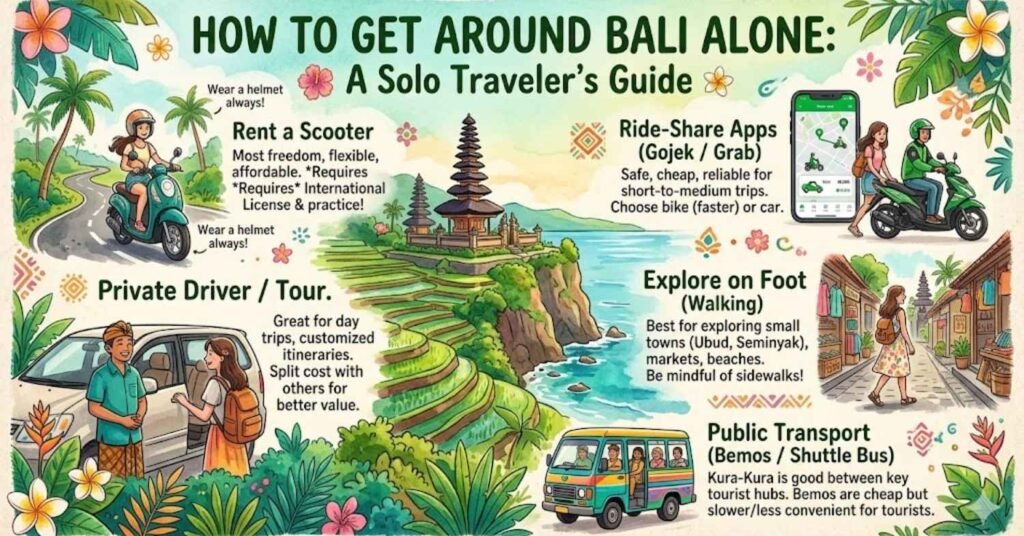
Getting around Bali solo is one of the most common practical concerns for first-time visitors and understandably so. There’s no public bus system worth relying on. No metro. No train. But the options available are actually quite good once you understand them.
Grab is your best friend in Bali. It’s Southeast Asia’s equivalent of Uber, it’s transparent with pricing, and it eliminates the painful negotiation process with local drivers. Download it before you land. Note that Grab can’t pick up passengers from certain areas (like inside the airport) due to local taxi regulations in those zones, use a metered Blue Bird taxi instead.
Metered taxis from Blue Bird Group are reliable and honest. Avoid unofficial taxis that approach you without a meter; they’ll charge three to five times the fair rate.
Scooter rental costs roughly $5–$8 per day and gives you complete freedom to explore on your own schedule. It’s the most popular choice among experienced solo travelers. However, risks are real. Only rent if you’ve ridden a scooter before. Always wear a helmet. Carry your international driver’s license. Check the scooter for existing damage before accepting it photograph everything to avoid being charged for pre-existing scratches.
Private drivers are an excellent option for longer day trips or rural excursions. You can hire an experienced local driver for $35–$60 for a full day. They know the roads, speak English, and often double as informal guides. Many solo travelers share driver costs by connecting with other travelers at their hostel.
| Transport Option | Cost | Best For | Drawback |
| Grab app | $2–$10 per ride | Short daily rides | Not available everywhere |
| Blue Bird Taxi | Metered fare | Airport, short trips | Can get stuck in traffic |
| Scooter rental | $5–$8/day | Freedom, flexibility | Road safety risks |
| Private driver | $35–$60/day | Day trips, rural areas | Higher daily cost |
| Tourist shuttle bus | $5–$15 per route | Intercity travel | Fixed schedule, slow |
Perama Tours and Kura-Kura Bus offer affordable shuttle services between major tourist areas. They’re slower than private taxis but work well for budget travelers moving between, say, Ubud and Canggu.
Bali Solo Travel Budget: Daily Costs, Money Tips & Saving Hacks
Bali is still genuinely affordable but it’s no longer as dirt-cheap as it was a decade ago. Budget planning for Bali solo travel requires realistic expectations based on your travel style.
Daily Budget Breakdown
| Budget Level | Daily Spend | What You Get |
| Backpacker | $25–$40/day | Dorm bed, local warungs, scooter |
| Mid-Range | $60–$100/day | Private room, good restaurants, occasional tours |
| Comfortable | $100–$180/day | Private villa, beach clubs, guided day trips |
| Luxury | $200+/day | Boutique hotels, fine dining, private transport |
The most effective money-saving hacks for Bali solo travel:
Eat at warungs (local family-run food stalls) whenever possible. A full meal of nasi campur (mixed rice) with multiple sides costs around $1.50–$3. The food is delicious, fresh, and genuinely representative of Balinese cuisine. Tourist restaurants in Seminyak charge five to ten times more for comparable quality.
Negotiate accommodation rates for longer stays. If you’re staying five or more nights, ask for a discount most guesthouses and small hotels will happily oblige. A $30/night room often drops to $22/night for a week-long stay.
Use ATMs attached to major banks BCA, Mandiri, and BNI are the most reliable. Avoid standalone ATMs in tourist areas; they often have skimming devices and charge higher fees. Withdraw larger amounts less frequently to minimize per-transaction fees.
Avoid booking tours through hotel lobbies. Walk 100 meters down the street and book directly with a tour operator. Prices drop by 30–40% instantly.
The rupiah is confusing at first. One US dollar equals roughly 15,000–16,000 Indonesian Rupiah. When someone quotes you “150,000 rupiah,” that’s about $10. Keep a mental conversion habit prevents overpaying in the confusion of large numbers.
SIM Cards, Internet & Connectivity in Bali
Staying connected during Bali solo travel is genuinely easy. Indonesia has several strong mobile networks and purchasing a local SIM card takes about ten minutes at the airport.
Telkomsel is the most reliable carrier with the widest coverage across Bali, including rural areas, north Bali, and the smaller islands. XL Axiata and Indosat Ooredoo are cheaper alternatives with solid coverage in tourist areas. For most solo travelers, Telkomsel is worth the small premium.
Where to buy a SIM card: Airport arrival hall (slightly overpriced but incredibly convenient), official carrier stores in Denpasar or Ubud, or any Indomaret/Alfamart convenience store. Bring your passport registration is required by Indonesian law.
Data packages are remarkably affordable. A 20–30 GB data package from Telkomsel costs around $5–$10 and lasts 30 days. That’s more than enough for maps, Instagram, video calls, and working remotely.
WiFi quality across Bali varies wildly. Co-working cafes in Canggu and Ubud generally offer fast, reliable connection speeds of 20–50 Mbps are common. Mid-range to luxury hotels usually provide solid WiFi. Budget guesthouses and rural areas can be unreliable. If you’re working remotely, don’t rely solely on accommodation WiFi; your local SIM card data is often more reliable.
eSIM options have become popular among solo travelers. Services like Airalo or Holafly let you purchase and activate a Bali data eSIM before you even land, which eliminates the airport SIM card hunt entirely. Particularly convenient if your phone supports eSIM functionality.
Booking Tours vs Exploring Solo: What’s Better in Bali?
This is one of the most common debates among Bali solo travelers and honestly, the answer isn’t binary. Both approaches have genuine strengths. The smart move is knowing when to use which.
Booking a guided tour makes sense when:
You’re visiting somewhere logistically complex or remote like Mount Batur (requires a guide by regulation), Sekumpul Waterfall in North Bali (difficult to find solo), or the Jatiluwih Rice Terraces (best understood with cultural context). Tours also make sense when you want to meet other travelers easily. Joining a small group snorkeling trip to Nusa Penida or a sunrise volcano hike naturally creates shared experiences and new friendships.
Exploring solo is better when:
You want to move at your own pace, linger somewhere longer than a tour allows, or discover something genuinely unexpected. Walking the Campuhan Ridge at your own speed. Sitting in a rice field café for three hours because the view is perfect. Stumbling on a village ceremony that wasn’t in any guidebook. These moments don’t happen on a bus schedule.
“The best travel stories rarely begin with ‘so we were on a group tour.’ They begin with ‘I got completely lost and then…’ ” a sentiment shared by almost every experienced solo traveler.
The hybrid approach works best. Book one or two structured tours for complex activities (volcano hike, Nusa Penida day trip). Spend the rest of your time exploring freely. You get the social benefits and logistical ease of guided experiences while preserving the freedom that makes solo travel meaningful in the first place.
Recommended platforms for booking tours in Bali:
Viator, GetYourGuide, and Klook all list verified operators with genuine reviews. Always read the reviews carefully. A reputable small group tour to Nusa Penida typically costs $35–$60 including boat transfers, entrance fees, and a guide.
Bali Food Guide for Solo Travelers (What to Eat & Where to Go)

Eating alone in Bali is never awkward it’s actually one of the best experiences the island offers. Food is central to Balinese life and culture. Every meal is an opportunity to understand the island more deeply.
Essential Balinese dishes every solo traveler must try:
Nasi Goreng: Indonesia’s iconic fried rice, typically topped with a fried egg, shrimp crackers, and pickled vegetables. Available everywhere, from humble warungs to five-star hotel restaurants. It’s comfort food and it’s extraordinary.
Babi Guling: Bali’s famous spit-roasted suckling pig, seasoned with a complex blend of turmeric, lemongrass, galangal, and garlic. Ibu Oka in Ubud is the most famous spot. Arrive before noon and it often sells out.
Nasi Campur: Mixed rice served with an assortment of small portions of meat, vegetables, peanuts, and sambal. Every warung has its own version. No two taste exactly alike.
Satay (Sate): Skewered, grilled meat served with peanut sauce. Chicken, pork, and minced meat versions all exist. Eaten as a snack or main meal.
Tempeh: Fermented soybean cake, pan-fried or deep-fried. Nutty, protein-rich, and delicious. Bali does tempeh better than almost anywhere in the world.
Jamu: Traditional Indonesian herbal drink made from turmeric, ginger, tamarind, and black pepper. Wellness-focused travelers drink it daily. It’s bitter and warming and genuinely medicinal.
| Dining Experience | Location | Price Range | Best For |
| Warung (local stall) | Everywhere | $1–$4 | Authentic, budget-friendly |
| Café | Canggu, Ubud | $4–$12 | Relaxed solo dining |
| Seafood restaurant | Jimbaran Bay | $15–$40 | Sunset dining experience |
| Fine dining | Seminyak, Ubud | $30–$80 | Special occasion |
| Night market | Gianyar, Denpasar | $1–$5 | Street food adventure |
Gianyar Night Market is one of Bali’s best kept secrets for food lovers. Located about 20 minutes from Ubud, this local night market serves traditional Balinese food at incredibly low prices. It’s where locals actually eat a refreshing contrast to the tourist café circuit.
For solo travelers with dietary restrictions, Bali is genuinely accommodating. Ubud and Canggu are overflowing with vegetarian and vegan options. Raw food restaurants, plant-based cafes, and gluten-free menus are everywhere. Communicating dietary needs is easy because most restaurant staff speak functional English.
See also: Solo Travel Amsterdam: See It Alone, Love It More!
How to Meet People in Bali as a Solo Traveler
One of the most frequently asked questions about Bali solo travel is how to avoid loneliness. The honest answer: it takes about 24 hours before you’re wondering how to get some time alone. Bali naturally brings people together in a way that few destinations manage.
Hostels are the most reliable social catalyst. Even if you prefer private rooms, book your first two or three nights in a social hostel. Common areas, communal breakfasts, and organized activities create instant conversation. Tribal Bali in Canggu has a rooftop pool and weekly events specifically designed for solo travelers to connect.
Co-working cafes in Canggu attract hundreds of digital nomads and solo travelers daily. Sit at a communal table, open your laptop, and conversations start naturally. Dojo Bali, Outpost, and Livit are the most popular co-working spaces many offer day passes and are explicitly community-oriented.
Yoga classes are extraordinary social connectors in Ubud. The Yoga Barn runs multiple classes daily and attracts a genuinely diverse international crowd. The shared experience of a sweaty, challenging yoga session creates surprisingly deep bonds quickly.
Surf lessons in Canggu or Kuta regularly place solo travelers together in small groups. Learning something together, laughing at your failures, and cheering each other’s progress is one of the fastest ways to form genuine connections.
Facebook groups like “Bali Expats and Travelers” and “Canggu Community Board” regularly post social meetups, group dinners, and day trip invitations. Meetup.com also lists regular social events across the island.
Couchsurfing Hangouts (now operating through its platform’s social events feature) occasionally hosts free meetups in Ubud and Canggu where locals and travelers gather specifically to connect. These are often wonderfully diverse, low-pressure social events.
Best Cafes & Work-Friendly Spots for Solo Travelers

Bali has quietly become one of the world’s great destinations for remote workers and digital nomads and the café culture reflects that. Whether you need fast WiFi for a video call, a beautiful setting for journaling, or a community vibe for focused work, Bali delivers consistently.
Best Cafes in Canggu for Solo Travelers
Satu Satu Coffee Company on Batu Bolong Street is consistently excellent with strong flat whites, reliable WiFi, and a convivial atmosphere that makes three hours feel like thirty minutes. Betelnut Café overlooks rice fields and serves outstanding smoothie bowls alongside genuinely good coffee. Crate Café has become a Canggu institution with enormous portions, strong coffee, and a social buzz that makes solo dining completely comfortable.
Nude in Canggu is popular with the health-conscious crowd, cold-pressed juices, raw food, and a beautifully designed interior that feels lifted straight from a Kinfolk magazine.
Best Cafes in Ubud for Solo Travelers
Seniman Coffee Studio is the undisputed champion of Ubud’s coffee scene. Specialty beans, meticulous brewing methods, and a knowledgeable staff that can talk about coffee processing for as long as you’re willing to listen. Alchemy is Ubud’s most famous raw vegan café the açaí bowls are genuinely extraordinary. Kafe Ubud overlooks the forest canopy and serves a mix of Indonesian and international food in a beautiful open-air setting.
Co-Working Spaces Worth Knowing
| Space | Location | Day Pass | WiFi Speed |
| Dojo Bali | Canggu | $15/day | 100+ Mbps |
| Outpost | Canggu & Ubud | $12/day | 50+ Mbps |
| Livit | Canggu | $10/day | 50+ Mbps |
| Hubud | Ubud | $12/day | 30+ Mbps |
Most of these spaces also offer monthly memberships, community events, and networking opportunities invaluable for solo travelers planning extended stays.
Common Challenges in Bali Solo Travel (And How to Handle Them)
Every destination has its rough edges. Bali solo travel is genuinely wonderful but pretending it’s perfect would be dishonest and unhelpful. Here’s what actually challenges solo travelers and exactly how to handle each situation.
Traffic and transportation confusion is the most universal frustration. Bali’s roads are chaotic, poorly signed, and prone to sudden gridlock. The solution is simple: use Grab for most rides, leave earlier than you think necessary, and never schedule activities back-to-back with tight time margins. Build buffer time into every plan.
Vendor pressure and persistent touts wear some travelers down, particularly in Kuta and near major temples. Touts selling tours, transport, or merchandise can be relentless. The most effective response is a calm, brief “no thank you” with confident eye contact then keep walking. Engaging in lengthy explanations or apologies only invites more pressure. It’s not rude to be firm.
Stomach issues affect a significant percentage of visitors during their first week. The combination of new food, heat, and different water bacteria is the usual culprit. Drink only bottled or filtered water. Avoid ice in drinks from street stalls. Eat at busy warungs where food turnover is high and ingredients are fresh. Carry rehydration salts and basic stomach medication.
Temple entry requirements catch many tourists off guard. Entering Balinese Hindu temples requires covering your shoulders and knees. A sarong is typically provided or available to rent at entrance gates. Some temples also require a ceremonial sash around your waist. Respect these requirements it’s genuinely not optional.
Language barrier in rural areas can be real outside tourist zones. Google Translate with offline Indonesian downloaded works well for basic communication. Learning five to ten words of Bahasa Indonesia terima kasih (thank you), tolong (please), berapa harganya (how much) generates enormous goodwill from locals.
Loneliness on difficult days is something honest solo travel guides rarely mention. It happens. The best response is to change your environment immediately, move to a hostel common area, take a class, or book a group activity. Bali has enough social infrastructure that isolation is almost always a choice rather than a circumstance.
Bali Solo Travel Mistakes to Avoid
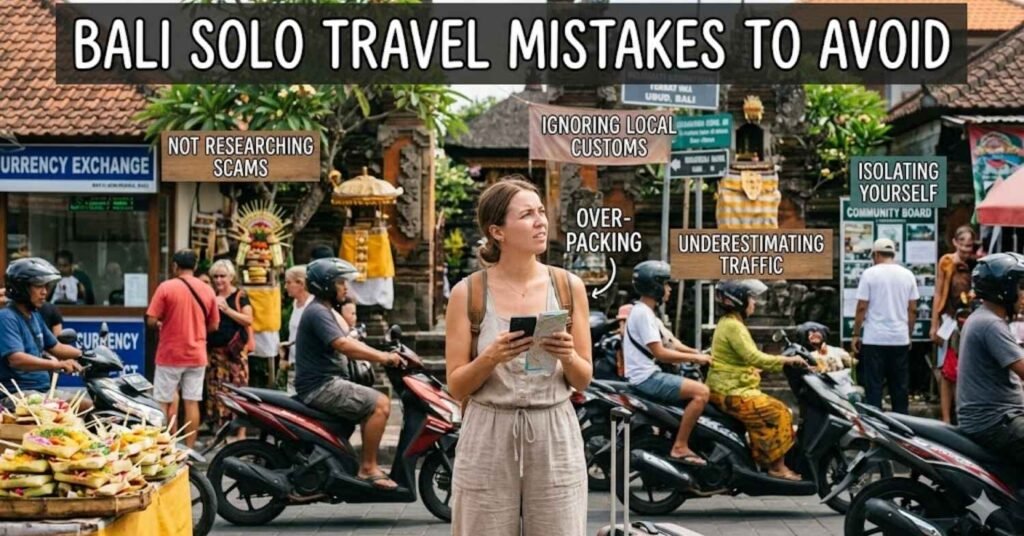
Learning from other people’s mistakes is vastly more efficient than making your own. These are the most common Bali solo travel mistakes and each one is entirely preventable.
Renting a scooter without experience is the single most dangerous mistake a visitor can make. Bali’s roads claim lives every year. If you haven’t ridden a motorbike before, hire a driver instead. Your ego isn’t worth a road rash or worse.
Exchanging money at the airport immediately costs you 10–15% in lost exchange rate compared to licensed moneychangers in town. Use airport ATMs for immediate cash needs and exchange the bulk of your money at PT Central Kuta or other reputable moneychangers in the tourist areas.
Overpacking is another trap. Bali is hot and humid year-round. You need light, breathable clothing not heavy jeans and multiple pairs of shoes. You can buy almost anything you forget in Bali’s markets at low prices. Pack half what you think you need.
Disrespecting temple etiquette, wearing shorts to a temple, climbing on sacred structures for photos, or wandering into restricted areas causes genuine offense to the Balinese community and increasingly results in tourist bans from specific sites. Always dress modestly, behave respectfully, and follow all posted guidelines.
Booking everything in advance is a surprisingly common mistake. Bali rewards flexibility. Locking every night’s accommodation into a non-refundable booking prevents you from staying longer somewhere you love or moving on quickly from somewhere that disappoints you. Book two to three nights in advance maximum and keep your options open.
Ignoring travel insurance is the riskiest financial mistake you can make. Medical costs for serious injuries in Bali particularly scooter accidents requiring hospitalization can run into tens of thousands of dollars. Comprehensive travel insurance including medical evacuation coverage is non-negotiable. World Nomads and SafetyWing are popular choices among solo travelers.
Underestimating distances between Bali’s attractions leads to exhausting, expensive days. Check actual driving times (not straight-line distances) before planning itineraries. Ubud to Uluwatu is roughly 1.5 hours. Canggu to Amed is close to 3 hours. Plan geographically clustered days.
Visa Rules, Entry Requirements & Avoiding Overstay Issues
Getting your Bali visa situation right before you travel prevents serious legal headaches. Indonesia has specific entry rules and violating them even accidentally carries real consequences.
Visa on Arrival (VoA)
Most nationalities qualify for a Visa on Arrival at Bali’s Ngurah Rai International Airport. This costs $35 USD (payable by card or cash) and grants you 30 days in Indonesia. You can extend it once at the nearest immigration office for an additional 30 days, bringing your total to 60 days. The extension costs approximately $35 and requires visiting the immigration office in Denpasar go early, bring passport photos, photocopies of your passport and visa, and proof of onward travel.
Visa-Free Countries
Certain nationalities including Singapore, Malaysia, Thailand, Brunei, Cambodia, Laos, Myanmar, Philippines, and Vietnam may enter Indonesia visa-free under ASEAN agreements. Check your country’s current status before travel as these arrangements change.
The Social Visa (B211A)
Solo travelers planning stays of 60–180 days often use the Social Cultural Visa (B211A), which must be obtained before arrival through an Indonesian consulate or a reputable visa agent. It allows a 60-day initial stay with extensions possible every 30 days up to 180 days total. This is the standard route for digital nomads and long-stay visitors.
Overstay Consequences
Never overstay your visa. Indonesia takes overstays seriously. Penalties include fines of approximately $20 USD per day overstayed, detention, deportation, and a potential ban from re-entering Indonesia. If you’re approaching your visa expiry date, either extend through immigration or depart and re-enter if eligible.
| Visa Type | Cost | Duration | Extendable |
| Visa on Arrival | $35 USD | 30 days | Yes, once (30 more days) |
| Visa Free (ASEAN) | Free | 30 days | No |
| Social Visa (B211A) | Varies | 60 days | Yes, up to 180 days |
| E-Visa (online) | $35 USD | 30 days | Yes, once |
The e-Visa option is now available for most nationalities through Indonesia’s official Molina immigration portal. Applying online before departure is slightly faster at the airport but costs the same as the on-arrival version.
Packing List for Bali Solo Travel Essentials
Packing smart for Bali solo travel means packing light, breathable, and practical. The climate is tropical. The activities are diverse. And you can buy almost anything forgotten at local markets.
Clothing
Pack light and embrace the heat. Two to three lightweight shirts, one pair of quick-dry shorts, one pair of lightweight long trousers (essential for temple visits), a swimsuit, flip flops, one pair of comfortable walking shoes, and one light layer for air-conditioned restaurants or cooler highland areas. That’s genuinely all you need for two weeks.
Health & Safety
| Item | Why You Need It |
| Sunscreen (SPF 50+) | Tropical sun is intense |
| Insect repellent (DEET) | Dengue fever is present in Bali |
| Rehydration salts | Heat + travel = dehydration risk |
| Basic stomach medication | Digestive adjustments are common |
| Travel insurance documents | Non-negotiable |
| First aid kit basics | Minor cuts, blisters |
Tech & Connectivity
Bring a universal power adapter (Indonesia uses Type C and F plugs). Pack a portable power bank for long days of navigation and photography. A waterproof phone case or dry bag protects your devices during water activities and rainy season downpours. Download Google Maps with Bali maps saved offline before you land, essential for scooter navigation in areas with unreliable signal.
Documents
Always carry photocopies of your passport and visa separately from your originals. Store digital copies in cloud storage (Google Drive or Dropbox). Bring your international driver’s license if you plan to rent a scooter. Carry a few passport photos needed for visa extensions and some tour bookings.
The Bali Packing Mindset
“Pack for the trip you’re actually going on, not the imaginary trip where you need every contingency covered.”
Bali has convenience stores on nearly every corner. Pharmacies are plentiful. Markets sell sarongs, clothing, and toiletries at low prices. What you forget, you can buy. What you overpack, you’ll carry in miserable tropical heat. Trust the island. Travel lighter than you think is possible. You won’t regret it.
Frequently Asked Questions
Is Bali a Good Solo Destination?
Yes, Bali is absolutely one of the best solo travel destinations in the world. Its welcoming culture, affordable costs, thriving backpacker community, and diverse experiences from Ubud’s rice terraces to Canggu’s surf breaks make it genuinely perfect for first-time and experienced solo travelers alike.
Is $1000 Enough for 1 Week in Bali?
Yes, $1000 covers a comfortable one-week Bali solo trip with room to spare. You can stay in a clean private room, eat well at local warungs and cafes, join guided tours, and still save money, especially if you avoid luxury beach clubs and overpriced tourist restaurants daily.
Is 2 Lakh Enough for a Bali Trip?
Yes, 2 lakh INR (approximately $2,400 USD) comfortably covers a 7–10 day Bali solo travel package including return flights from India, mid-range accommodation, daily meals, transport, and activities. Traveling during shoulder season and eating at local spots stretches this budget even further.
Is Bali a Good Place for Singles?
Bali is genuinely one of the friendliest places on earth for single travelers. Its buzzing hostel scene, yoga retreats, surf schools, co-working cafes, and social group tours make meeting people effortless; loneliness here is rare if you simply step outside your accommodation.
Can I Kiss My Girlfriend in Bali?
Casual affection like holding hands or a quick kiss is generally tolerated in tourist areas of Bali like Seminyak and Canggu. However, public displays of affection should be kept modest, especially near Hindu temples or traditional villages, where conservative local values deserve genuine respect.
Is $100 a Day Enough in Bali?
$100 a day in Bali is actually quite generous; it covers a private villa or boutique hotel, three quality meals, local transport via Grab, and entrance fees to attractions. Mid-range solo travelers typically spend $50–$70 daily, making $100 a comfortable and flexible Bali daily budget.
Conclusion
Bali solo travel is truly one of those experiences that changes how you see yourself and the world. From choosing the safest neighborhoods and planning your visa correctly to finding hidden gems, managing your daily budget, and meeting incredible people along the way, this guide covered every practical detail you need to arrive confident and leave transformed.
Personally, diving deep into everything Bali offers reminded me why solo travel matters so much. It strips away every excuse and puts you face-to-face with your own courage. Bali doesn’t just welcome solo travelers, it quietly teaches them something irreplaceable about freedom, trust, and showing up for yourself. Pack light, stay curious, and simply go.

Rajesh Khanna writes solo travel guides that actually help you go. No fluff, no generic tips just real advice from someone who has walked those streets alone. With 5+ years of solo travel experience across multiple continents, he covers everything from safety and budgeting to hidden gems most tourists never find. On Solivoy Route, his one goal is simple: make you confident enough to book that trip alone.