
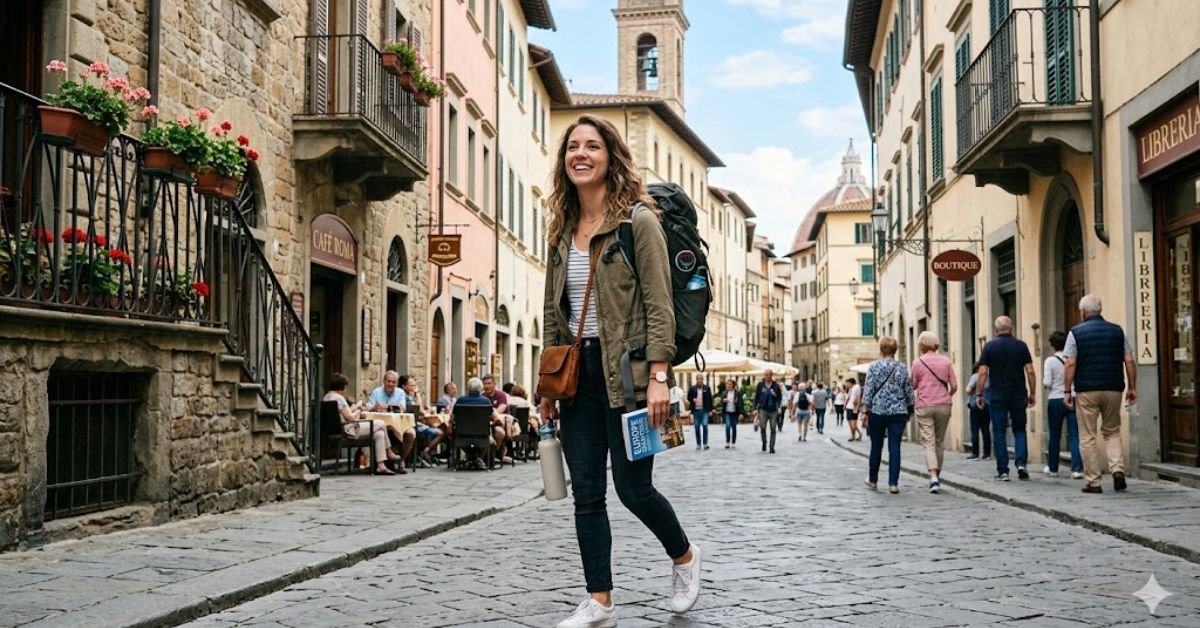
You’ve dreamed about it for months wandering cobblestone streets in Prague, sipping espresso alone in Rome, finally doing something just for you. But somewhere between excitement and booking that flight, fear creeps in. Is it safe? Will I feel lonely? Can I really do this alone? You can. Millions of women do it every year and they come back transformed.
I’ve spent time researching solo female travel across Europe, talking to seasoned women travelers who’ve navigated everything from budget hostels in Budapest to night trains through Scandinavia. The verdict is unanimous: Europe ranks among the most welcoming destinations for women traveling solo.
This Europe solo travel guide for women covers everything you need from the safest European cities for solo female travelers and smart packing tips to budget planning, local transportation, and building confidence on the road. Whether you’re a first-time solo traveler or a returning adventurer, this guide helps you travel smarter, safer, and on your own terms.
Why Europe is Perfect for Solo Female Travelers
There’s something quietly revolutionary about a woman packing one bag, booking a one-way ticket, and heading to Europe alone. No compromises. No waiting for someone else’s schedule. Just you, your curiosity, and an entire continent full of stories waiting to happen.
Europe isn’t just traveler-friendly, it’s practically built for solo exploration. The infrastructure alone makes it one of the most accessible regions on earth. Trains connect major cities within hours. Budget airlines hop between countries for the price of a dinner out. English speakers find their way easily, even in countries where locals primarily speak another language. For a solo female traveler, these practical advantages matter enormously.
Beyond logistics, Europe offers something harder to quantify: a culture of independent travel that normalizes women eating alone, exploring museums solo, or sitting quietly at a wine bar with a book. Nobody stares. Nobody asks uncomfortable questions. In cities like Amsterdam, Copenhagen, or Lisbon, solo women travelers blend right in because locals do the same thing every day.
The numbers back this up. According to a Condor Ferries travel report, solo travel has grown by over 42% in the last decade, and women now make up the majority of solo travelers worldwide. Europe consistently ranks as the top destination choice. That’s not a coincidence it reflects real safety, real accessibility, and real freedom.
Europe also rewards slow travel beautifully. You don’t need a packed itinerary to feel like you’re making the most of your trip. Spend three days in a small Slovenian town. Wander a Portuguese fishing village with no agenda. Take the scenic train through the Swiss Alps just because you can. Solo travel gives you that gift and Europe gives you the canvas.
Is It Safe? Honest Country-by-Country Safety Guide
Let’s be real. Safety is the first question almost every woman asks before booking a solo trip to Europe. And it deserves a real, honest answer not a vague “Europe is generally safe” non-answer that tells you nothing useful.
The truth? Europe is one of the safest regions in the world for solo female travelers. But safety isn’t uniform across every country or city. Pickpocketing hotspots, regions with higher street harassment rates, and areas where solo women attract unwanted attention do exist. Knowing the difference helps you travel smarter, not more fearfully.
Here’s an honest, country-by-country safety breakdown based on traveler reports, Global Peace Index rankings, and real female traveler experiences:
| Country | Safety Rating | Notes for Solo Women |
| Iceland | ⭐⭐⭐⭐⭐ | Consistently ranked safest country globally |
| Portugal | ⭐⭐⭐⭐⭐ | Low crime, extremely welcoming, great for first-timers |
| Switzerland | ⭐⭐⭐⭐⭐ | Very safe, efficient, and respectful culture |
| Netherlands | ⭐⭐⭐⭐ | Safe but watch for bike lanes and bag snatching in cities |
| Germany | ⭐⭐⭐⭐ | Very safe overall; stay alert in busy train stations |
| Spain | ⭐⭐⭐⭐ | Safe but pickpocketing is common in Barcelona & Madrid |
| France | ⭐⭐⭐⭐ | Paris requires extra vigilance in tourist zones |
| Italy | ⭐⭐⭐ | Street harassment can occur; confidence is your best armor |
| Czech Republic | ⭐⭐⭐ | Prague’s tourist areas attract scammers; go beyond the center |
| Greece | ⭐⭐⭐⭐ | Islands feel very safe; stay aware in parts of Athens |
| Hungary | ⭐⭐⭐ | Budapest is fun and mostly safe; avoid poorly lit areas at night |
| Turkey (Istanbul) | ⭐⭐⭐ | Rewarding but requires more active awareness |
| Albania | ⭐⭐⭐ | Underrated gem; locals are hospitable, scams are rare |
The most common risks in Europe aren’t violent crime, they’re petty theft, scams targeting tourists, and occasionally, street harassment. Keep your bag in front of you. Don’t flash expensive cameras or jewelry. Trust your gut when a situation feels off. These simple habits eliminate 90% of the risks.
“The moment I stopped looking like a confused tourist and started walking with purpose, my entire experience in Naples changed. Confidence really is the best travel accessory.” Solo traveler, shared via Solo Female Travelers Community
Night safety matters too. Research your accommodation neighborhood before you book. Walking home at midnight in central Reykjavik feels completely different from doing the same in a poorly lit backstreet in Rome. That doesn’t mean you avoid nights out it means you choose your routes wisely and keep your phone charged.
Registering with the U.S. State Department’s STEP program before you travel gives you real-time safety alerts for every country you visit. It takes ten minutes and it’s completely free. Do it before every trip.
Best Destinations for Solo Women in Europe [By Travel Style]
Not every solo traveler wants the same thing. Some chase history and architecture. Others want beach days, nightlife, or off-grid hiking trails with zero crowds. Europe has every flavor. The trick is matching the destination to your travel personality.
Best European Cities for Solo Female Travelers Who Love Culture & History
Lisbon, Portugal is where most solo female travelers fall in love with Europe. The city moves slowly and warmly. The historic Alfama district winds uphill in a labyrinth of tiled buildings and fado music. Locals are genuinely friendly. The food is outrageously good for the price. And the city feels safe at nearly every hour. Lisbon rewards wandering you don’t need a plan to have a perfect day here.
Prague, Czech Republic dazzles architecturally in a way that genuinely stops you mid-step. The Old Town Square, Charles Bridge, and Prague Castle form one of Europe’s most photogenic trifectas. Travel beyond the tourist center though neighborhoods like Vinohrady and Žižkov give you a more authentic, less crowded experience. Solo dining is completely normal here and the café culture is incredible.
Athens, Greece layers thousands of years of civilization into one chaotic, electric city. Visiting the Acropolis at sunrise before the crowds arrive is a solo travel experience that stays with you for years. The Monastiraki flea market, rooftop bars with Parthenon views, and the warmth of Greek hospitality make Athens a deeply rewarding solo destination.
Best Destinations for Solo Women Who Want Nature & Outdoor Adventure
The Swiss Alps don’t require a travel companion to enjoy. Train routes like the Glacier Express or Bernina Express do the scenic work for you you simply sit, watch, and feel small in the best possible way. Hiking trails around Interlaken and Zermatt are well-marked and heavily traveled, making them ideal for solo hikers who want stunning scenery without isolation risk.
The Scottish Highlands offer raw, dramatic landscapes unlike anything else in Europe. Drive the North Coast 500 route solo and you’ll encounter castles, lochs, and almost zero other tourists. The Scottish people are famously welcoming. Solo female road-trippers consistently rate this as one of Europe’s best kept secrets.
Slovenia remains criminally underrated. Lake Bled looks photoshopped in real life a glacial lake with a church-topped island and a medieval castle perched above it. Triglav National Park offers serious hiking for the adventurous. And Ljubljana, the capital, charms visitors with its pedestrian-friendly center and excellent café scene.
Best Destinations for Solo Women Who Want Sun, Beach & Relaxation

The Algarve, Portugal strings together some of Europe’s most dramatic coastline. Golden cliffs, hidden grottos, and long stretches of uncrowded beach make it ideal for solo travelers who want to decompress. Towns like Lagos and Tavira have strong expat and backpacker communities it’s genuinely easy to meet people here if you want to, and equally easy to have peaceful solitude if you don’t.
Santorini and Crete, Greece both deliver that iconic Mediterranean dream. Santorini is better for atmosphere and photography. There’s something transcendent about watching the sunset from Oia alone with a glass of local wine. Crete offers more diversity: mountain villages, Minoan ruins, and long stretches of beach that never feel overcrowded outside peak season.
Montenegro’s Bay of Kotor gives you the dramatic coastline of the Amalfi Coast at a fraction of the price and crowd level. The medieval walled town is compact, walkable, and almost absurdly beautiful. Solo travelers consistently describe Montenegro as their unexpected favorite European discovery.
When to Go Seasons, Crowds & Costs Explained
Timing your Europe trip well can save you hundreds of dollars and make your entire experience dramatically more enjoyable. Peak season, shoulder season, and off-season each offer completely different versions of the same destination.
Peak Season (June – August) means maximum sunshine, maximum crowds, and maximum prices. Popular destinations like Santorini, the Amalfi Coast, Barcelona, and Paris become genuinely overwhelming in July and August. Accommodation prices spike. Popular attractions require advance booking weeks or months out. The weather is excellent but the experience can feel rushed and crowded.
Shoulder Season (April–May and September–October) is where experienced solo travelers tend to agree with the magic lives. Crowds thin noticeably. Prices drop by 20–40% compared to peak summer. The weather remains comfortable and reliable across most of Europe. September in particular hits a sweet spot school is back in session in most countries, beaches clear out, but temperatures stay warm enough for comfortable travel.
Off-Season (November – March) rewards the flexible and the budget-conscious. Cities like Prague, Vienna, Budapest, and Lisbon transform beautifully with winter Christmas markets, cozy cafés, and a more authentic local atmosphere replacing the summer tourist rush. You’ll pay significantly less for accommodation and flights. However, some coastal destinations and Alpine hiking trails close or become inaccessible.
Here’s a practical seasonal breakdown:
| Season | Months | Pros | Cons |
| Peak | June – August | Best weather, most events | Crowds, high prices, booking pressure |
| Shoulder | April–May, Sept–Oct | Good weather, fewer crowds, better prices | Some attractions may have limited hours |
| Off-Season | November – March | Lowest prices, authentic atmosphere | Cold in Northern Europe, some closures |
For solo women travelers on a budget, shoulder season consistently delivers the best value. For first-timers who want the full sunny Europe experience, late May or early September threads the needle between good weather and manageable crowds.
Getting to Europe from the USA (Cheapest Ways)
Flying to Europe from the USA doesn’t have to drain your travel budget before your trip even starts. With the right strategy, transatlantic flights can cost as little as $300–$500 round trip sometimes even less.
The single most important tool in your flight-hunting arsenal is Google Flights (flights.google.com). Set up price alerts for your preferred travel window and let the algorithm track prices for you. The “Explore” feature lets you search flexibly by date and destination perfectly if you have some flexibility on where or when you go.
Budget transatlantic airlines have genuinely changed the game. Norse Atlantic, Icelandair, and Level all offer significantly cheaper fares than legacy carriers on popular routes. The trade-off is fewer amenities, bring your own snacks, pay for checked bags, and don’t expect much legroom. For a long-haul flight, that’s worth knowing upfront.
Gateway cities matter more than you might think. Flying into London, Amsterdam, Dublin, or Lisbon typically produces cheaper fares than flying directly into Paris or Rome. Once you’re in Europe, budget airlines and trains make internal travel cheap and easy so starting your trip in a slightly different city rarely creates problems.
Here are the most practical tips for finding cheap transatlantic flights:
Book 6–8 weeks in advance for the best prices on peak season travel. For off-season or shoulder season travel, last-minute deals do exist but don’t rely on them for a once-a-year trip.
Tuesday and Wednesday flights consistently price lower than weekend departures. If your schedule allows flexibility, mid-week travel saves real money.
Use miles and points strategically. Credit cards like the Chase Sapphire Preferred and American Express Gold accumulate transferable points that can slash transatlantic flight costs dramatically. Several travel bloggers have detailed how to fly business class to Europe for essentially free using points resources like The Points Guy walk through the strategies clearly.
Getting Around Europe Train, Bus & Flight Guide
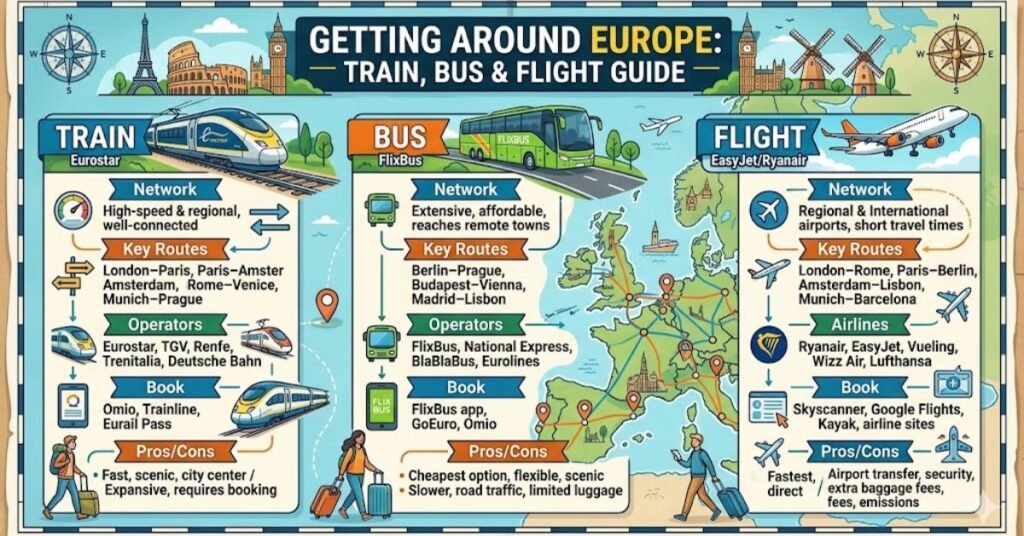
Once you land in Europe, getting around becomes one of the most enjoyable parts of the trip. The continent’s transportation network is genuinely world-class and learning how to use it confidently transforms your travel experience.
Trains: The Soul of European Travel
Train travel in Europe doesn’t just move you from point A to point B it is part of the experience. Watching the French countryside blur past your window, or arriving in a Swiss mountain town by rail as the morning mist lifts, creates memories that airport terminals never could.
Eurail Passes (eurail.com) offer unlimited train travel across participating countries for a set number of days. They make financial sense if you plan to cover significant ground traveling between four or more countries over two weeks typically justifies the cost. However, for shorter trips or if you’re staying primarily in one or two countries, booking individual tickets in advance often costs less.
Country-specific rail passes offer excellent value in certain destinations. The Swiss Travel Pass gives unlimited access to trains, buses, and boats throughout Switzerland one of Europe’s most expensive countries and frequently pays for itself within two or three days of travel.
For high-speed international routes, booking 60–90 days in advance secures the best prices. The Paris–London Eurostar, Paris–Barcelona TGV, and Amsterdam–Paris routes all offer early-bird fares that can be shockingly affordable.
Budget Buses: Slower but Cheaper
FlixBus (flixbus.com) has quietly become one of Europe’s most useful budget travel tools. Routes connect hundreds of cities across the continent at prices that often undercut trains significantly. The trade-off is time a bus journey that takes four hours by train might take seven by bus. For overnight routes, though, buses save you both transportation costs and a night’s accommodation.
BlaBlaCar offers a rideshare option that locals actually use extensively. Drivers heading between cities list available seats at low prices. It works especially well for reaching smaller towns not served by major rail lines.
Budget Flights Within Europe
Ryanair, EasyJet, and Wizz Air operate extensive networks of ultra-cheap intra-European flights. A flight from London to Lisbon or Barcelona to Krakow can cost as little as €15–€30 if you book early and travel light. The golden rule: only bring a personal item or small carry-on to avoid bag fees that can triple your base fare.
Use Skyscanner (skyscanner.com) to compare all options flights, buses, and trains for any given route. The “everywhere” search function lets you discover which destinations fit your budget on any given travel date.
Where to Stay Accommodation Options Compared
Choosing where to sleep shapes your solo travel experience more than almost any other decision. Europe offers every accommodation tier imaginable from €15 hostel dorms to boutique hotels and private apartments. Each has real advantages depending on your travel style, budget, and social preferences.
Hostels remain the heartbeat of solo budget travel in Europe. Modern hostels have evolved far beyond the bare-bones dormitory stereotype. Places like Generator Hostels and St Christopher’s Inns operate across major European cities with private rooms, rooftop bars, organized social events, and genuinely comfortable facilities. For solo women who want to meet other travelers organically, hostels provide a social infrastructure that hotels simply don’t offer.
Female-only dormitory rooms offered by most quality hostels give solo women the social benefits of hostel travel with an added layer of comfort and privacy. If you’ve never stayed in a hostel before, booking a female dorm in a well-reviewed property is the ideal introduction.
Guesthouses and B&Bs occupy a sweet spot between hostels and hotels. Family-run guesthouses across Portugal, Italy, Greece, and the Balkans offer genuine local hospitality, home-cooked breakfasts, and insider knowledge about the area that no travel app can replicate. Prices typically run €40–€80 per night and the personal touch is hard to overstate.
Airbnb and VRBO work particularly well for longer stays or if you want a home base with kitchen access a genuine budget-saver when you can prepare some of your own meals. Entire apartments give you privacy, space, and a local neighborhood experience. However, research your host carefully, read recent reviews, and confirm the exact neighborhood location before booking.
Budget hotels in Europe particularly in Eastern and Central Europe offer extraordinary value. A clean, centrally located three-star hotel in Budapest, Krakow, or Sarajevo might cost €50–€70 per night, with breakfast included. Western European cities command higher prices for the same standard.
Here’s a quick comparison:
| Accommodation Type | Average Cost/Night | Best For | Social Factor |
| Hostel Dorm | €15–€35 | Budget travelers, meeting people | Very High |
| Hostel Private Room | €40–€70 | Budget + privacy balance | Medium |
| Guesthouse / B&B | €40–€90 | Local experience, comfort | Medium |
| Budget Hotel | €60–€120 | Comfort, reliability | Low |
| Airbnb (entire flat) | €60–€150 | Longer stays, kitchen access | Low |
| Boutique Hotel | €100–€250+ | Splurge nights, special locations | Low |
Always read reviews specifically written by solo female travelers when choosing accommodation. Platforms like Hostelworld and Booking.com let you filter by reviewer gender and travel type use that feature. The details that matter to you (lighting in the room, security lockers, neighborhood safety at night) often appear only in solo female reviews.
How Much Does It Cost? Budget Breakdown by Region
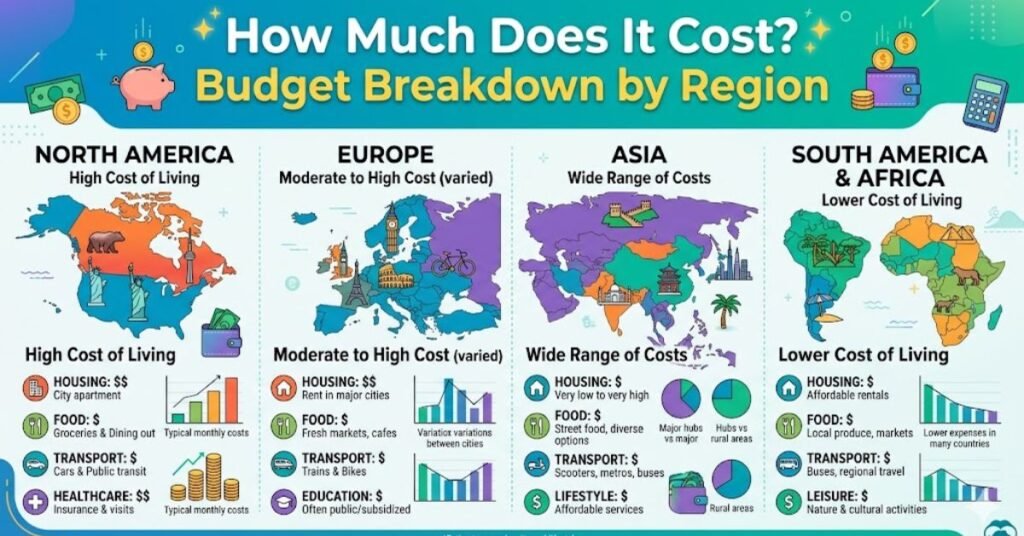
One of the most common questions solo women ask before their Europe trip is: How much money do I actually need? The honest answer is that it depends enormously on your travel style, destinations, and habits but real numbers help far more than vague estimates.
Europe divides broadly into three cost tiers: Western Europe, Central Europe, and Eastern/Balkan Europe. Understanding the difference before you plan your route can reshape your budget dramatically.
Western Europe (France, UK, Switzerland, Scandinavia, Netherlands) commands premium prices. Expect to spend €100–€200+ per day if you want reasonable comfort in cities like Paris, London, Zurich, or Oslo. Budget travelers who stay in hostels, self-cater occasionally, and use free attractions can bring this down to €70–€90 but it requires discipline.
Central Europe (Germany, Austria, Czech Republic, Poland, Hungary) offers a significant value improvement. €60–€100 per day comfortably covers accommodation, meals, transport, and entertainment in cities like Berlin, Vienna, Prague, and Budapest. This region punches well above its weight in terms of culture, architecture, and food quality relative to cost.
Eastern and Balkan Europe (Albania, Montenegro, North Macedonia, Bosnia, Romania, Bulgaria) delivers exceptional value. €35–€60 per day covers you well in most of these countries. Albania in particular has become a word-of-mouth favorite among budget solo travelers extraordinary coastline, welcoming locals, and prices that feel like Europe fifteen years ago.
| Region | Daily Budget (Budget) | Daily Budget (Mid-Range) | Daily Budget (Comfortable) |
| Western Europe | €70–€90 | €120–€160 | €200+ |
| Central Europe | €50–€70 | €80–€110 | €130–€160 |
| Eastern/Balkans | €30–€50 | €55–€80 | €90–€120 |
The biggest budget leaks in solo travel tend to be accommodation (paying single-room rates), tourist restaurants near major attractions, and last-minute transportation bookings. Combat all three: book accommodation early, walk ten minutes from the main square to find local restaurants at half the price, and buy train and bus tickets at least a few days in advance.
A two-week Europe trip for a solo female traveler covering two or three countries typically costs $2,000–$3,500 all-in (flights included from the USA) on a mid-range budget. Budget-focused travelers who stick to Eastern Europe and use hostels can do it for $1,200–$1,800. Those who prefer more comfort and hit Western cities should budget $4,000–$6,000.
Sample Itineraries [10 Days / 2 Weeks / 3 Weeks]
Planning a solo Europe itinerary feels overwhelming until you break it into manageable blocks. These three itineraries cover different budget levels and travel styles treat them as flexible templates, not rigid schedules.
10-Day Solo Europe Itinerary (First-Timer Friendly)
This itinerary focuses on two countries to keep logistics simple and give you real depth of experience rather than a surface-level tour.
Days 1–4: Lisbon, Portugal Arrive, recover from jet lag, and ease into solo travel at Europe’s most welcoming gateway city. Explore Alfama, ride Tram 28, visit the Jerónimos Monastery, and take a day trip to Sintra’s fairy-tale palaces. Eat pastel de nata every single day without apology.
Days 5–6: Porto, Portugal Take the Alfa Pendular train north (under three hours). Explore the Ribeira district, cross the Dom Luís Bridge on foot, and do a port wine tasting in Vila Nova de Gaia. Porto rewards slow walking and spontaneous discovery.
Days 7–10: Seville, Spain Fly or take the train across the border. Seville’s Real Alcázar, Flamenco shows, and tapas culture make it one of Europe’s most vibrant cities. The evenings come alive here in a way that feels cinematic. Solo dining is completely comfortable. Tapas bars are made for it.
2-Week Solo Europe Itinerary (Culture + Nature Mix)
Days 1–3: Amsterdam, Netherlands Canal walks, world-class museums (Rijksmuseum, Van Gogh Museum), and the best cycling culture in Europe. Rent a bike and immediately feel like a local.
Days 4–6: Berlin, Germany History, street art, incredible food, and a nightlife scene unlike any other city in Europe. The East Side Gallery, Brandenburg Gate, and Checkpoint Charlie cover the historical weight. Kreuzberg neighborhood covers everything else.
Days 7–9: Prague, Czech Republic Architecture that makes you question whether you’ve stepped into a novel. Spend time in neighborhoods beyond the tourist center for a more authentic experience.
Days 10–11: Vienna, Austria Coffeehouses, Klimt paintings, Mozart history, and the kind of elegant grandeur that makes you walk slower and appreciate more. The Kunsthistorisches Museum alone justifies a full day.
Days 12–14: Ljubljana & Lake Bled, Slovenia End on a breathtaking note. Ljubljana’s compact, walkable center charms immediately. Lake Bled a ninety-minute bus ride away delivers one of Europe’s most iconic views. Row to the island. Hike to the castle. Breathe it all in.
3-Week Solo Europe Itinerary (Deep Dive)
Week 1: Iberian Peninsula Lisbon (3 nights), Porto (2 nights), Seville (2 nights). Follow the 10-day itinerary structure above.
Week 2: Mediterranean Core Barcelona (3 nights) for Gaudí and beach culture, then fly to Rome (4 nights) for the Colosseum, Vatican, and the best pasta of your life.
Week 3: Balkan Discovery Fly to Dubrovnik, Croatia (2 nights) for the walled city and Game of Thrones scenery, then take the bus to Kotor, Montenegro (2 nights) for the bay views, then finish in Tirana or Berat, Albania (3 nights) for extraordinary value and untouched authenticity.
What to Pack Women’s Packing List for Europe

Overpacking is the most common solo travel mistake. Every extra kilogram you carry becomes a burden on cobblestone streets, metro staircases, and budget airline gates. Pack light. Pack intentionally.
The guiding principle: plan for one week of outfits maximum, regardless of trip length. Europe has laundromats, Airbnbs with washing machines, and hand-washing works fine for light items. You don’t need fourteen outfits for a fourteen-day trip.
Clothing Essentials
Pack clothes that mix and match effortlessly. Three or four neutral-colored tops, two pairs of pants or one skirt and one pair of jeans, one dress that works for both daytime sightseeing and an evening out, a lightweight layer for cooler evenings, and comfortable walking shoes cover nearly every situation. Merino wool items pack small, resist odor, and work across a wide temperature range worth the investment for frequent travelers.
One pair of versatile walking shoes plus one pair of sandals or light evening shoes handles most scenarios. Don’t bring heels unless you genuinely plan to use them European cobblestones are unforgiving.
Documents & Money
Keep physical copies of your passport, travel insurance policy, and emergency contacts stored separately from your originals. A money belt or neck wallet worn under your clothes protects your passport and emergency cash from pickpockets. Carry a small amount of local currency for the first day in each country; not everywhere accepts cards immediately upon arrival.
Tech & Accessories
A universal travel adapter is non-negotiable in Europe. The Anker PowerCore portable charger keeps your devices alive through long travel days. Noise-canceling earbuds transform long train journeys. A lightweight packable daypack keeps your hands free for sightseeing without looking like an obvious tourist.
Here’s a consolidated packing list:
| Category | Items |
| Clothing | 3–4 tops, 2 bottoms, 1 dress, 1 layer, underwear x7, socks x5 |
| Shoes | Walking shoes, sandals or flats |
| Toiletries | Solid shampoo bar, moisturizer with SPF, travel-size essentials |
| Health | Prescription medications, basic first aid, hand sanitizer |
| Documents | Passport, copies, travel insurance, credit/debit cards |
| Tech | Phone, universal adapter, portable charger, earbuds |
| Extras | Packing cubes, reusable water bottle, small lock for hostel lockers |
Essential Apps & Tech Tools
Your smartphone becomes your most powerful travel companion in Europe but only if you’ve loaded it with the right tools before you land.
Navigation & Transport
Google Maps works offline in Europe download maps for each country before you arrive. Maps.me offers an excellent offline alternative with detailed walking routes. Omio (omio.com) compares trains, buses, and flights across Europe in one search, making route planning dramatically simpler. Citymapper works brilliantly for navigating public transport in major European cities.
Accommodation & Booking
Hostelworld remains the gold standard for hostel booking, with reliable reviews from a genuinely useful community of solo travelers. Booking.com covers hotels, guesthouses, and apartments with flexible cancellation policies that suit dynamic travel plans.
Safety & Communication
Google Translate with offline language packs downloaded saves you in countless situations — from reading menus to understanding street signs. WhatsApp is the universal communication standard across Europe locals, other travelers, and accommodation hosts all use it. Make sure your family or emergency contacts can reach you on it.
The State Department’s STEP enrollment (step.state.gov) sends real-time safety alerts to your email. TravelSafe Pro consolidates emergency numbers, hospital locations, and embassy contacts for every country worth having even if you never need it.
Money Management
Wise (formerly TransferWise) offers real exchange rates with minimal fees for international transfers and card payments significantly better than traditional bank cards for international spending. Revolut works similarly and adds budgeting features that help you track spending across currencies. Both cards work contactlessly across Europe and reload instantly from your phone.
Safety Tips Beyond the Basics
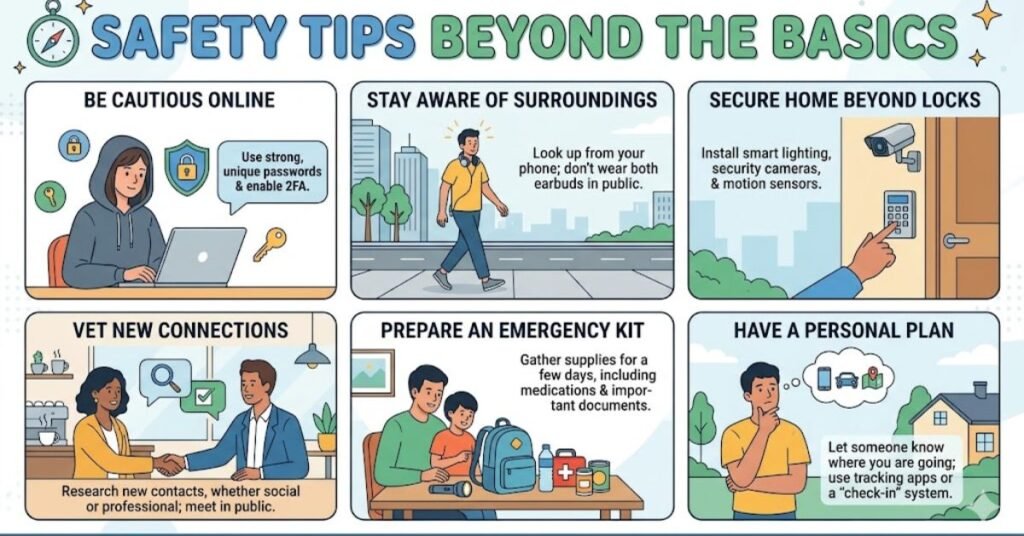
Most solo travel safety guides tell you to “stay aware of your surroundings” and “trust your instincts.” That advice isn’t wrong but it isn’t enough either. Real safety comes from specific habits and knowledge, not generic reminders.
Build a communication routine. Tell one trusted person at home your rough itinerary. Check in every two or three days a simple WhatsApp message takes thirty seconds and gives someone at home a baseline if anything ever goes wrong. Share your accommodation name and address for each night’s stay.
Master the art of confident body language. Research consistently shows that pickpockets and opportunistic scammers target people who look uncertain, distracted, or lost. Walk purposefully. Look up rather than constantly at your phone. When you need to check directions, step into a café or shop not in the middle of a busy tourist area where you’re surrounded by strangers.
The fake stumble and distraction scam operates in almost every major European tourist city. Someone “accidentally” spills something on you, an accomplice rifles through your bag while you’re distracted. The moment a stranger touches you unexpectedly in a crowded area, grip your bag and step away immediately.
Drink smarter, not less. Solo travel doesn’t mean you can’t enjoy European wine, craft beer, or cocktails. It means knowing your limit in unfamiliar environments. Always know how you’re getting back to your accommodation before you start drinking. Have the address saved on your phone and a backup plan if your first transport option falls through.
Accommodation security matters beyond just the lock on the door. Use the door chain or additional door stopper when sleeping. Most modern hostels provide secure lockers and use them for your passport and electronics every night. Before booking any accommodation, check that it has 24-hour reception or at minimum a secure keypad entry.
The “wrong turn” protocol: If you realize you’ve wandered into an area that feels unsafe at night, don’t freeze. Walk into the nearest open business, a restaurant, convenience store, or hotel lobby. Reorient yourself inside. Call a taxi or rideshare from there rather than continuing on foot.
First-Timer’s Mindset Overcoming Fear & Loneliness
Here’s the part most solo travel guides skip. The logistics flights, trains, accommodation are actually the easy part. The harder challenge is managing the mental and emotional landscape of traveling alone.
The fear before your first solo trip is real and it’s normal. Every experienced solo traveler remembers it. The sleepless nights wondering if you’re crazy for doing this. The moment at the departure gate when part of your brain screams “turn around.” That fear doesn’t mean you shouldn’t go. It means you care about the experience and that means it will matter.
Loneliness is the fear that looms largest for most first-timers. The honest truth? You will feel lonely at certain moments. A particularly beautiful sunset hits differently when there’s nobody beside you to nudge and say “look at that.” A moment of confusion or frustration with zero familiar faces around feels more acute than it would at home. These moments are part of the experience, not evidence that you’ve made a mistake.
What experienced solo travelers discover almost universally is that loneliness and solitude are not the same thing. Solitude is choosing to sit quietly at a harbor with your thoughts and a coffee and feeling completely at peace. Loneliness is painful; solitude is nourishing. Most solo travel swings much more toward solitude than loneliness, especially once you find your rhythm.
Practical strategies that genuinely help:
Stay in social accommodation (hostels or guesthouses) for at least part of your trip, especially as a first-timer. The built-in community eliminates loneliness almost instantly. Join a free walking tour in each new city; they’re excellent, informative, and reliably attended by other solo travelers. Apps like Meetup and Couchsurfing’s social events (not just the accommodation side) connect travelers with locals and other visitors for group activities.
Give yourself permission to have bad days. Travel isn’t Instagram content. Some days the trains are late, your feet hurt, the hostel has thin walls, and you miss home. That’s allowed. Get an early night, reset, and the city looks different in the morning light.
“Solo travel didn’t make me fearless. It made me realize that I could act despite the fear and that’s the only kind of courage that counts.”
The woman who lands home after her first solo Europe trip is measurably different from the one who boarded the outbound flight. More confident. More self-aware. More capable. That transformation is real and it starts the moment you book the ticket.
May you like also: Solo Travel NYC: The Ultimate Guide to Exploring New York Alone
US-Specific Logistics Passport, eSIM, Insurance & STEP
If you’re traveling to Europe from the United States, a specific set of practical logistics apply to you that won’t appear in general Europe travel guides. Getting these right before you leave saves significant stress on the ground.
Passport & Entry Requirements
Your U.S. passport must be valid for at least six months beyond your travel dates to enter most European countries, a rule that catches first-timers off guard. Check your expiration date immediately. Passport renewal currently takes 8–11 weeks through standard processing and up to 3 weeks with expedited service plan well ahead of your travel dates.
U.S. citizens can travel visa-free across Schengen Zone countries for up to 90 days within any 180-day period. The Schengen Zone covers 27 European countries including France, Germany, Spain, Italy, Portugal, Greece, and most of Central and Eastern Europe. The UK, Ireland, Albania, and several Balkan nations operate outside the Schengen agreement with their own entry rules each separately.
ETIAS launches in 2025 a new electronic travel authorization for U.S. visitors entering the Schengen Zone, similar to the ESTA system for travel to the U.S. It costs approximately €7 and must be obtained before travel. Check etias.com for the most current status and application process.
eSIM: The Solo Traveler’s Best Friend
Buying a local SIM card in every country you visit used to be the budget solution for international data. eSIM technology has made that obsolete. An eSIM installs digitally on your phone and lets you activate a data plan instantly, no physical card swapping required.
Airalo (airalo.com) offers affordable eSIM plans covering all of Europe for 15–30 days. A regional European plan typically costs $15–$35 for 3–10GB of data vastly cheaper than international roaming through U.S. carriers. Check that your phone supports eSIM before purchasing (most iPhones from XS onward and many Android flagships do).
Travel Insurance: Non-Negotiable
Travel insurance isn’t optional for solo female travelers, it’s essential. Medical costs in Western Europe can exceed $10,000 for a serious incident without coverage. Beyond medical, comprehensive policies cover trip cancellation, lost luggage, flight delays, and emergency evacuation.
World Nomads (worldnomads.com) remains the most popular choice among solo and adventure travelers globally; their policies cover a wide range of activities and are straightforward to extend mid-trip. Allianz Travel and SafetyWing offer competitive alternatives worth comparing.
When comparing policies, prioritize these coverage categories: emergency medical (minimum $100,000), medical evacuation ($250,000+), trip cancellation, and 24/7 emergency assistance. Read the exclusions carefully some policies exclude alcohol-related incidents, pre-existing conditions, or certain adventure activities.
STEP Registration
The Smart Traveler Enrollment Program (STEP) from the U.S. State Department takes ten minutes and delivers real value. Register at step.state.gov before every international trip. STEP provides:
Real-time safety and security alerts for every country you register travel to. Easier assistance from the nearest U.S. Embassy or Consulate if something goes wrong. Notification to your emergency contact if there’s a crisis in your destination country.
Save the contact information for the nearest U.S. Embassy in each country you visit in your phone before you arrive. In a genuine emergency, having that number immediately accessible matters.
Frequently Asked Questions
Is Europe safe for solo female travelers from the USA?
Yes, Europe ranks among the safest regions globally for solo women. Countries like Iceland, Portugal, and Switzerland consistently top safety indexes for female travelers.
What is the best country in Europe for first-time solo female travelers?
Portugal is widely considered the best starting point. Lisbon offers a welcoming culture, low crime rates, and an easy-to-navigate layout perfect for first-time solo travel in Europe.
How much money do I need for a solo Europe trip as a woman?
A comfortable two-week solo Europe trip typically costs $2,500–$4,000 all-in from the USA, including flights. Eastern Europe destinations cut that budget significantly.
Do I need a visa to travel to Europe from the USA?
No visa is required for U.S. citizens visiting Schengen Zone countries for up to 90 days. However, the new ETIAS travel authorization launches soon and will require a small fee.
What is the safest city in Europe for a solo woman traveler?
Reykjavik, Iceland leads nearly every safety ranking for solo female travel in Europe. Lisbon, Copenhagen, and Vienna follow closely behind.
What should a solo female traveler pack for Europe?
Pack light with versatile clothing, a universal adapter, a money belt for travel security, offline maps, and a portable charger. Merino wool layers work brilliantly across seasons.
Which European cities are best for solo female travelers who love culture?
Lisbon, Prague, Athens, and Vienna offer world-class culture, walkable historic centers, and environments where solo women feel completely comfortable exploring independently.
How do solo female travelers stay safe in Europe at night?
Walk confidently, stick to well-lit areas, pre-plan your route home before going out, and always keep your phone charged. Rideshare apps like Uber operate widely across Europe.
What is the cheapest way to get to Europe from the USA solo?
Book through Google Flights with flexible dates, target mid-week departures, and consider budget transatlantic carriers like Norse Atlantic. Shoulder season fares drop prices by 30–40%.
Is solo travel in Europe lonely for women?
Occasional loneliness is normal but rarely lasts long. Staying in social hostels, joining free walking tours, and using apps like Meetup connect you with other travelers almost instantly.
What travel insurance do solo female travelers need for Europe?
Choose a policy covering emergency medical expenses (minimum $100,000), evacuation, and trip cancellation. World Nomads and Allianz are top-rated options among experienced solo women travelers.
What is the best time of year for solo female travel in Europe?
Shoulder season May and September delivers the best balance of good weather, manageable crowds, and lower prices across most European destinations.
Conclusion
This Europe solo travel guide for women covers everything you genuinely need from country-by-country safety insights and budget breakdowns to packing lists, sample itineraries, and the mindset shifts that make solo travel transformative. Europe isn’t just accessible for women traveling alone, it actively rewards the decision.
Writing this guide reinforced something worth saying out loud: the women who take that first solo trip rarely regret it. The fear before departure is loud. The confidence you carry home afterward is louder. Whether you’re planning ten days in Portugal or three weeks across the Balkans, trust yourself enough to book it. The cobblestones, the sunsets, the quiet café mornings they’re all waiting for you.

Rajesh Khanna writes solo travel guides that actually help you go. No fluff, no generic tips just real advice from someone who has walked those streets alone. With 5+ years of solo travel experience across multiple continents, he covers everything from safety and budgeting to hidden gems most tourists never find. On Solivoy Route, his one goal is simple: make you confident enough to book that trip alone.